
Reconnecting the pieces of the living system
People often come for treatment because they are in pain. Back pain. Neck tension. Discomfort in the pelvis. Restricted breathing. Fatigue that settles in. A sense of a body that feels heavy, closed, or less available.
The symptom is usually the starting point. It draws attention. It disturbs. It limits. It sometimes forces a pause. But the symptom does not always tell the whole story.
A pain may be local, but it often belongs to a broader organisation: a body that compensates, a nervous system that remains vigilant, breathing that becomes shorter, an emotional load that has not yet found a way to be expressed, accumulated fatigue, or a more demanding period of life.
Returning to the foundations of osteopathy
From its origins, osteopathy has carried a strong intuition: the body cannot be separated from the person who inhabits it. Andrew Taylor Still, the founder of osteopathy, did not simply propose a manual technique. He defended a way of understanding the living body: the body as a unit, the constant relationship between structure and function, the importance of circulation, and the body's capacity for self-regulation when the conditions allow it.
A restriction of mobility is not merely a loss of range. It can modify a function. A mechanical constraint is not only local. It can influence breathing, circulation, nervous transmission, pain perception, or adaptive capacity. A symptom is not simply an isolated signal. It always belongs to a larger whole.
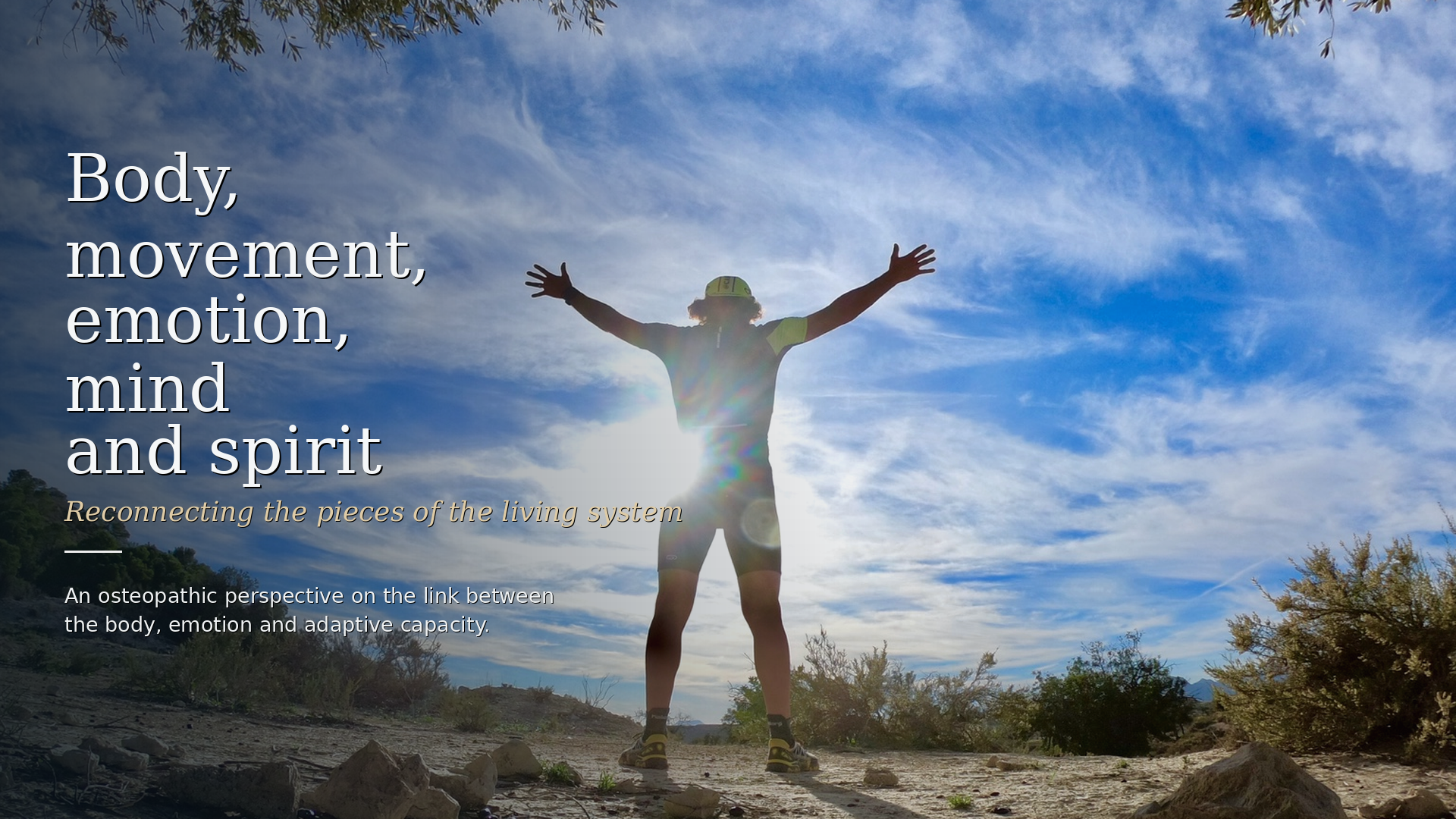
In this continuity, osteopathy can be read through several gateways: body, motion, emotion, mind and spirit. The body. Movement. Emotion. Consciousness. The deep coherence of the person. These are not separate elements. They are different expressions of the same living system.
The body as an entry point
The body often shows what the person is living through before it can be clearly formulated in words. It tightens. It closes. It holds back. It protects. It compensates. It becomes exhausted. It tries to keep functioning despite the load.
A clenched jaw, a closed thorax, a tense diaphragm, a vigilant neck, a contracted abdomen, high breathing, or a fixed pelvis are not necessarily isolated 'problems'. They may be expressions of a broader organisation.
This does not mean that everything is emotional. That would be too simple. Pain may have a mechanical, tissue-related, inflammatory, postural, traumatic, or load-related origin. But it may also be influenced by stress, fear, fatigue, lack of recovery, personal context, or the way the nervous system interprets the situation. The body is not only a place of pain. It is also a place of information.
Movement as a principle of life
In osteopathy, movement is central. But movement is not limited to a joint moving or a muscle stretching. It concerns breathing, circulation, fluids, tissues, support, tone, coordination, and the relationship between structure and function.
A living body is a body that exchanges. It receives. It transmits. It drains. It nourishes. It eliminates. It adapts. Movement participates in this dynamic. It supports the circulation of fluids, the nutritional supply of tissues, the removal of metabolic waste, the quality of exchange, and the availability of structures.
When a body loses movement, it often loses part of its margin: mechanical, respiratory, circulatory, nervous, energetic, and adaptive. And when it recovers movement, it does not only recover range. It may also recover space, breathing, safety, better circulation, greater availability, and the capacity not to remain fixed in a single way of functioning.
Emotion as a bodily event
An emotion is not merely something we understand with the head. It is a lived experience. An event that permeates the body. It passes through the breath, the abdomen, the throat, the heart, the muscles, posture, gaze, voice, rhythm, support, and the relationship with others.
Fear modifies breathing and prepares the body to react. Anger increases tone. Unexpressed anger can establish a more lasting tension, because the mobilised energy finds no channel of expression. Sadness can close the thorax, slow down impulse, and modify posture. Chronic stress progressively exhausts the nervous system through prolonged activation of alert mechanisms.
But this requires caution. The body cannot be read as a symbolic dictionary. We cannot say automatically: this pain equals this emotion, this restricted area means this trauma, this symptom means this story. The body does not offer ready-made translations. It shows living organisations. And these organisations must be listened to with precision, without imposing a ready-made interpretation on the person.
Recognising, naming, integrating
Sometimes the body provides information, but consciousness has not yet been able to grasp it. A person feels tension, but does not know what they are holding back. They feel fatigue, but do not yet measure what they are carrying. They feel oppression, but cannot yet name what is suffocating them. They feel a blockage, but do not yet know what has become fixed.
Between bodily sensation and conscious understanding, there is sometimes a delay. This delay depends on each person's history, education, environment, and on the place that has been given to the body, emotions, speech, vulnerability, and self-listening.
Therapeutic work sometimes consists in reconnecting sensation, bodily information, emotion, and consciousness. Osteopathy aims to help the body recover mobility, better breathing, tissue availability, safety in movement, and a greater capacity for adaptation. But certain dimensions also require work through awareness, speech, expression, relationship, and integration.
The role of osteopathy
Osteopathy does not replace psychological or psychotherapeutic work. It does not consist in 'making emotions come out', nor in interpreting the patient's inner life from bodily restrictions. Its role is different.
When certain chronic constraints decrease, the nervous system can gradually move out of a permanent state of alert. The body then recovers less rigidity, more mobility, greater internal safety, and a better capacity for adaptation.
Recovering coherence
To care is not only to try to make a symptom disappear. It is sometimes to help a person recover a more accurate relationship with their body, their story, their inner movement, and their adaptive capacity.
A body can feel better without everything being 'resolved'. An emotion can be present without controlling the whole person. A pain can become less threatening when it is understood within a broader whole.
Reconnecting the pieces of the living system
For a long time, our culture has tended to separate body and mind. This separation has sometimes been useful for analysing, classifying, and understanding. But when it becomes too rigid, it fragments the living system.
On one side, the body as mechanics. On the other, emotions as a psychological problem. Between the two, a person who no longer always knows how to connect what they feel, what they are living through, and what their body expresses.
Yet the living system does not function in separate pieces. The body helps consciousness return to the present. Emotion gives information about what is being lived. Movement allows the system not to remain fixed. Consciousness allows what was only felt to become integrated. And inner coherence gives direction again.
It is in this space that care can become deeper. Not by opposing the body and emotion. Not by reducing everything to mechanics. Not by explaining everything through psychology. But by reconnecting the pieces of the living system.
They are a living system to be listened to, accompanied, and brought back into movement.