
FROM CAVE DIVING TO THE TOUR DE FRANCE
Two extreme worlds. One shared lesson: the living can only be understood through its margin, its constraints, its resources, and its capacity for adaptation.
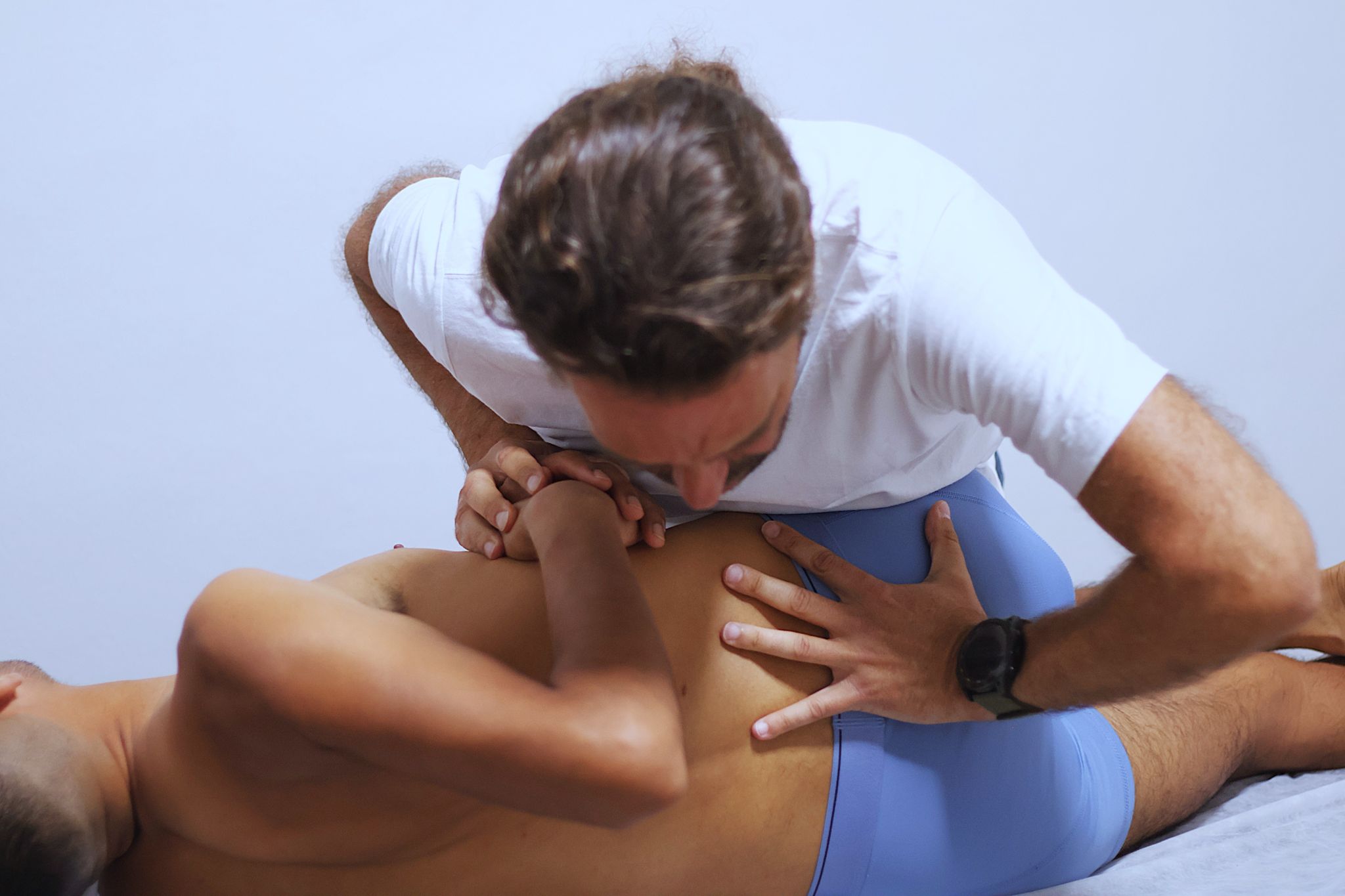
Two worlds that seemed opposed
At first glance, few things seem to bring together a flooded underground gallery, a treatment table, and elite sport. And yet, these worlds have taught me common laws: reading the margin, respecting thresholds, the need for adaptation, and the importance of understanding a body not as an isolated object, but as a living being that is situated, conditioned, and in constant reorganization.
For a long time, my life was built between two worlds that seemed opposed: cave diving and osteopathy. Over time I understood that both had taught me the same thing: the living cannot be reduced to what it shows. It is read in its margin, in its constraints, in its resources, in its history, and in its present capacity to integrate what happens to it.
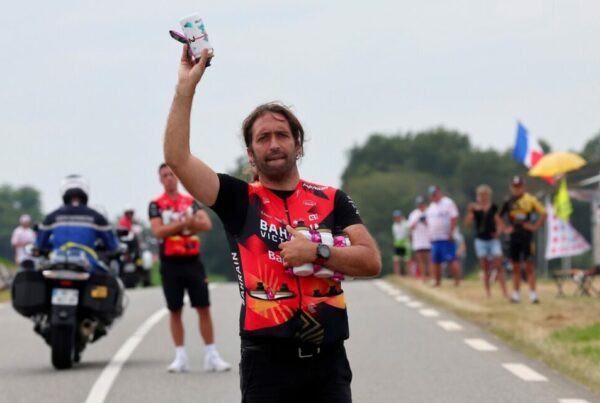
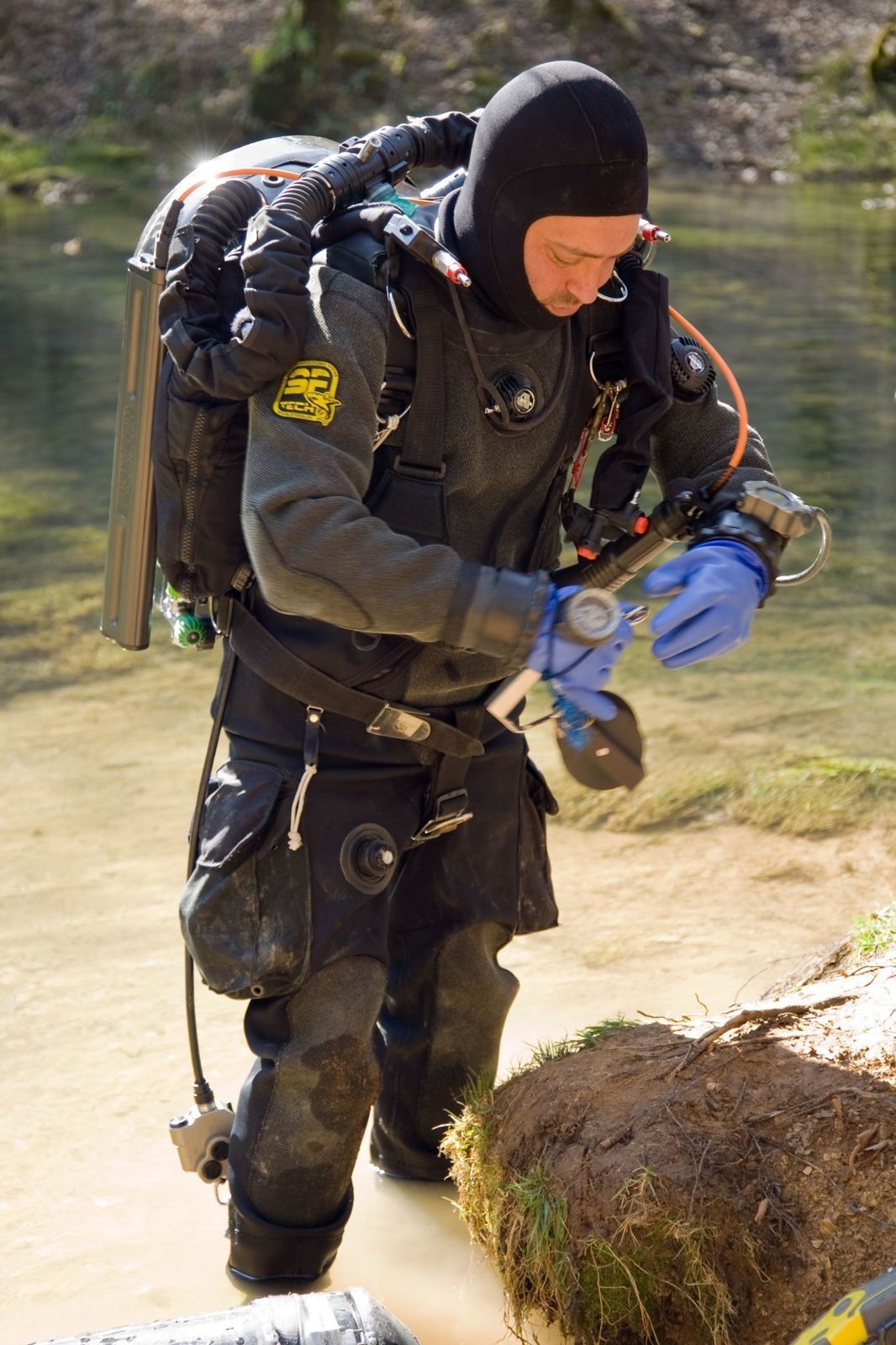
One of those worlds unfolded underground: silence, narrowness, mineral dampness, uncertainty, the need to quickly read an environment that does not forgive approximation. The other was built in contact with bodies, patients, athletes, and later with elite sport, WorldTour cycling, and the Tour de France. A universe that appears more visible, but also crossed by its silent constraints, its quick decisions, its narrow margins, and its precarious balances.
For a long time I believed they were two separate paths. Over time I understood that they converged toward the same demand: to observe without simplifying, to respect thresholds, to read ongoing adaptations, and never to forget that a body can only be understood in relation to its environment and the state of the system at the moment we encounter it.
The underground does not teach domination. It teaches precision.
When people imagine cave diving, they easily project a taste for risk or the search for heroic feats. That remains a superficial view.
The underground does not reward theatricality or brutality. It demands something else: preparation, sobriety, precision, clarity, and above all, an intimate understanding of margin.
Error does not always take a spectacular form. It can be discreet: an imperfect reading, a delayed decision, an extra tension, a poorly integrated detail, a plan one clings to long after it should have been abandoned.
There are situations where persisting worsens the problem, where stubbornness becomes more dangerous than the obstacle itself, where moving forward, surviving, or simply returning demands less power than finesse, less ego than discernment.
The underground world also teaches something else: you never progress only on the way in. Each advance already commits the return. Each stage consumes part of the margin that will still need to be managed later. You learn to respect a plan, to integrate progressiveness, to understand that certain loads saturate even before becoming visible, and that the right time to stop is not always the one the ego would choose.
It is a school of humility. A school of reading. Also a school of relationship. Because no one seriously explores such an environment with the illusion of individual omnipotence. The reliability of the partner, the quality of support, and collective intelligence are decisive.
Care and elite sport are no less extreme. They are extreme in a different way.
Over the years I found these same laws again in clinical practice, in accompanying patients, and later in elite sport.
At first glance, everything seems to oppose an osteopathy consultation, a team bus in a major race, and a flooded underground gallery. In reality, the similarities are profound.
In both universes you have to learn to quickly read what is really happening. In both, the essential is not always where the superficial gaze thinks it is. In both, weak signals announce the loss of margin long before the visible breakdown.
Safety does not depend only on technical skills. It also depends on the ability to perceive early, to adjust, not to tell oneself stories, and not to confuse tenacity with rigidity.
In clinical practice we do not only find symptoms. We find living systems in adaptation: people who have sometimes been holding on for a long time, bodies that compensate, breathing that changes, tissues that protect themselves, organisms that keep going at an increasing cost.
In elite sport this becomes even clearer. An athlete who performs is not merely a strong body; it is an exposed system: to load, to expectations, to travel, to accumulated fatigue, to lack of recovery, and to the pressure of results.
The real question, therefore, is not only: can he hold up? It is often more subtle: how much margin is left?
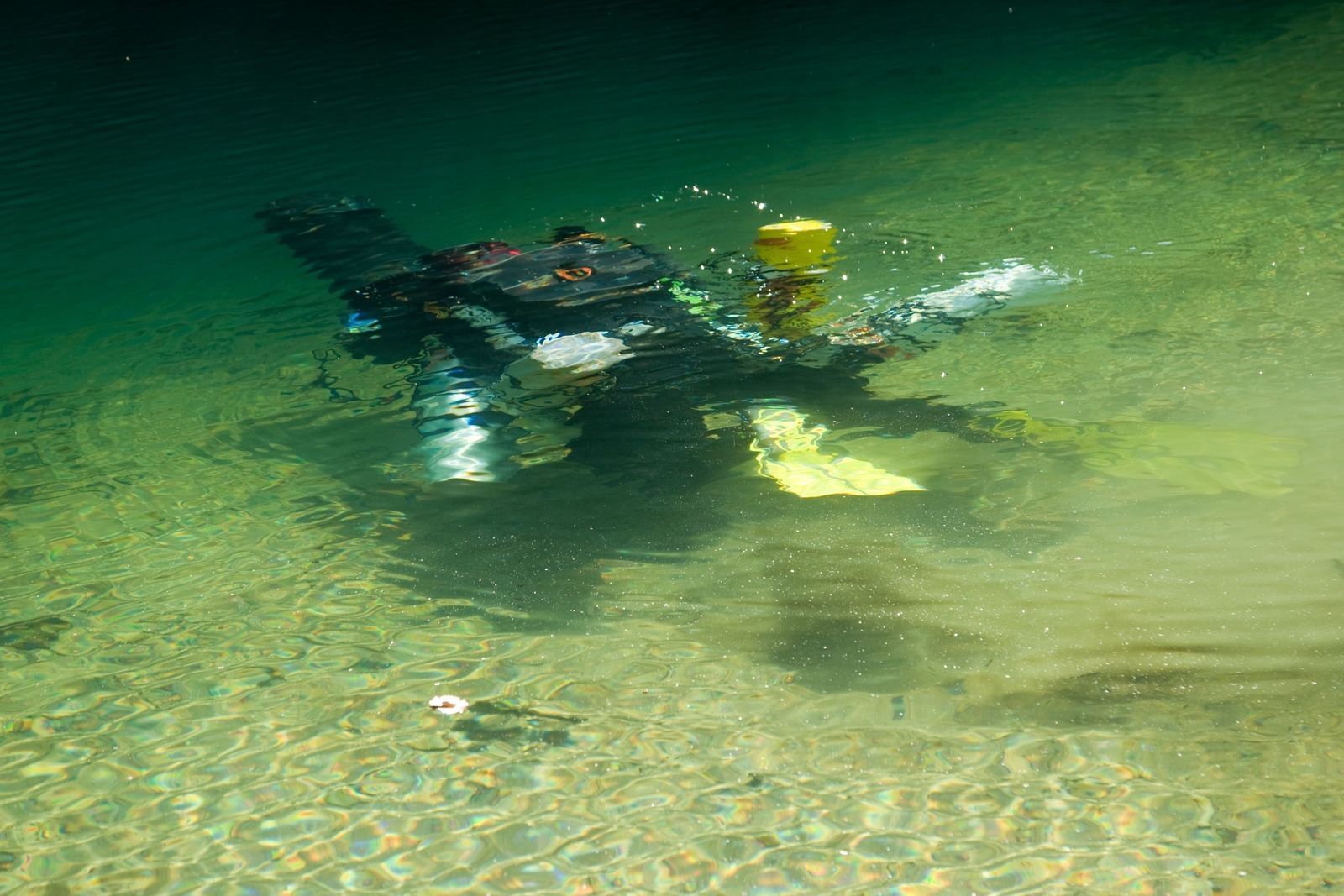
What these two worlds have taught me
With the perspective of time, I would not simply say that cave diving has served me in my profession, nor that osteopathy has enriched my way of exploring. I would say rather that these two worlds have shaped in me a single way of reading the living.
They have taught me that constraint is never a sufficient brute fact by itself. The same constraint does not produce the same effects depending on the state of the system that receives it. A difficulty, a load, a pressure, a compression, an effort, or an event can only be understood in relation to the adaptive capacity of the living at the moment those forces act upon it.
We talk a lot about load, stress, intensity. But what seems decisive to me is never only what acts upon the human being. It is the state of the human being at the moment those constraints act upon him or her.
In other words, it is not the constraint alone that determines the effect, but the encounter between the constraint and the adaptive capacity of the system. A well-dosed constraint can structure. An excessive, brutal, or poorly integrated constraint can trap. And a system that already lacks margin does not need a big shock to become even more disorganized.
Over time, this way of reading the living ended up asking for a name. Not to fix it, but to better respect it in its complexity. That is how the idea of Bioterreno was born for me: a reading grid attentive to the state of the system, its margin, its resources, its visible and invisible constraints, and its present capacity to integrate what happens to it.
Not a model meant to simplify everything, but a reading filter to better respect the complexity of the living.
Care as help to get through a passage
Over time, my way of thinking about care shifted. I no longer see it only as an action aimed at correcting, relieving, or normalizing, but also as help to get through a passage.
It is then about regaining some margin, moving away from a logic of excessive compression, restoring mobility to a body that had organized itself in protection, allowing breathing to descend again, and helping a person not to confuse adaptation with chronic exhaustion.
From this perspective, the professional is not an all-powerful external repairer, but rather a point of support, a reader, a companion, sometimes a temporary regulator, sometimes a revealer of what was already at stake.
This applies to the everyday patient, to the athlete, and also, in a certain way, to each of us in certain periods of life. Because we all go through, sooner or later, narrow passages.
Phases where old strategies no longer suffice. Moments when you can no longer get through as before. Periods when you need to push less and feel more, harden less and adjust more, agitate less and regain clarity.
What these worlds teach
The body knows very early when space begins to narrow
One of the aspects that strikes me most, in all these worlds, is how quickly the body knows.
Long before explanations, and sometimes long before words, the body registers the reduction of margin.
Breathing changes, tone rises, movement stiffens. Perception narrows, variability decreases, the field of decision shrinks, and finesse is lost.
This is true for the diver faced with a sudden constraint. It is true for the athlete who has been compensating for too long. It is true for the patient who says "I'm fine" when everything shows they are holding on more than they are actually fine.
The body often speaks before discourse. It says that inner space has shrunk.
And when that space shrinks, panic itself becomes an aggravating factor. It consumes margin, accelerates what it would like to prevent, and stiffens what sometimes needs to soften.
This is where presence, perception, and adjustment become decisive. Not to deny the constraint, but to get through it without losing oneself.
Elite sport: an underground world in the open air
There is, in elite sport, something that sometimes resembles an underground world in the open air. Everything seems visible: bodies, performances, rankings, numbers, images, victories, failures. And yet, the essential often remains invisible.
Nervous load, underlying fatigue, relational tension, the cost of a calendar, the weight of a role, lack of sleep, the need to keep functioning while inner space shrinks.
In these contexts, care cannot be reduced to a technique applied to a symptom. It demands a broader reading: seeing the body, of course, but also the human terrain, the environment, the moment, the visible and invisible load, and the ongoing adaptive logic.
Elite sport has also taught me that a highly exposed system is not always an impoverished system. In some very high-level cyclists, when they are going through a great phase of form, the body's response to an intervention can be almost immediate. As if, despite the load, the living then possesses a quality of availability, reactivity, and adaptation that is especially readable.
Conversely, when margin has been impoverished, when fatigue has accumulated, or when the system is already saturated, the response becomes slower, more costly, sometimes more diffuse. Once again, it is not only the intervention that makes the difference, but the state of the living that receives it.
This also requires understanding that a tissue, a gesture, a pain, a fatigue, or a constraint are not mere local events, but are inscribed in a more global organization.
This is where a significant part of my vision was consolidated: in the conviction that the body can only be read in relation to the living that inhabits it and the context in which that system tries to sustain itself, perform, recover, or simply continue.
The living has its thresholds, its stops, and its times to respect
In the underground world there are phases of compression, saturation, desaturation, times that must be respected, and decompression stops that cannot be negotiated without cost. The living also has its thresholds, its silent accumulations, and its irreducible recovery times.
You can delay signals, sometimes mask them, ignore them for a while. But reality does not disappear.
Perhaps that is also why these worlds ended up uniting so strongly in me. They taught me that a system can still appear functional while already being engaged in a logic of saturation. They also taught me that the return can be more demanding than the way in, that an apparent exit does not always mean real recovery, and that there are moments when respecting a stop, slowing down, or interrupting is not a renunciation, but a superior form of clarity.
A vision of the living
If I had to summarize what cave diving, osteopathy, and elite sport have woven together in me, I would say this:
The living is understood neither as an assembly of separate parts nor through a romanticized vision. It demands an exacting, embodied, concrete, and relational reading.
A reading attentive to constraints as much as to resources, to warning signs as much as to possibilities of reorganization, to structure as much as to function, to the body as much as to the environment, to technique as much as to human presence.
What these worlds have taught me is not limited to a way of intervening. They have taught me to look differently, to respect more deeply, to perceive when force becomes counterproductive, to understand that regained margin is sometimes worth more than an additional directive.
Some situations are not better navigated by becoming more rigid. They are often better navigated by rediscovering precision.
The deep question is not only how much you can endure, but how much margin, flexibility, clarity, and support remain available to get through the constraint without losing yourself and without breaking.